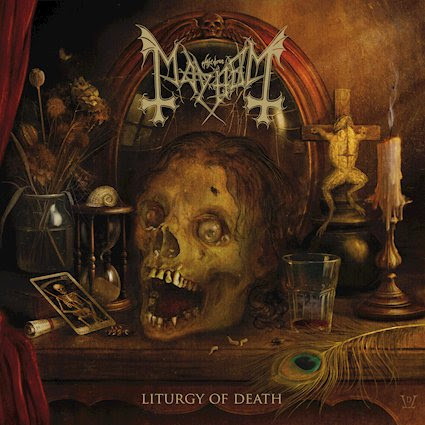

Century Media, released on 6 February 2026
Two thoughts kept bouncing around my head as I listened to the new Mayhem album, Liturgy of Death; firstly, ‘no compromise’. This album makes no concessions to anyone, except the musicians themselves. That, as a result, leaves the album in danger of ‘polarising’ the fan base. It is no secret that fans have been divided about Mayhem’s output since the release of De Mysteriis Dom Sathanas, and whilst all fans regard the classic line-up’s recordings as definitive, there has been much angst about the Blasphemer years; for some it was too dense, too technical, too inaccessible. Others, myself included, regarded those years as a band re-defining not only themselves but the genre itself. With the departure of Maniac and Blasphemer, a new Mayhem was born, and for the past twelve years this line-up has been stable, touring consistently, and have produced three albums, not inconsequential, as Mayhem, in forty-two years of existence, have only produced seven albums and a smattering of EPs.
Liturgy of Death contains eight tracks and lasts for approximately forty-nine minutes. Three of those tracks, Weep for Nothing, Despair, and Life Is a Corpse You Drag have, at the time of writing, been released as singles, a practise common nowadays, but one I take umbrage to! Please note that the special edition of Liturgy of Death contains two bonus tracks; Life Is a Corpse You Drag, and Sancta Mendacia neither of which were available to me for this review. You can find Life Is a Corpse You Drag on all streaming services.
Enough of that, Ephemeral Eternity opens with a Bladerunner-esque sound of muted drums set against synthesisers, but here it tilts towards something ominous and full of dread. This dread is picked up in the opening riff, doom-laden and intense; a swirling chorus provides the background to Attila’s astonishing vocal performance. The song lurches off into a punishing drum and twin guitar attack and it has to be said that Hellhammer’s playing has surely never been this good. The song is full of atmosphere and the frequent time changes actually enhance the overall mood. It’s disconcerting, jagged, and weirdly addictive. The guitars, during the slower moments, are menacing and perfectly balance the echo-drenched vocals. A simple riff emerges, not distorted or crushing, but it serves as a sinister motif. Toward the end, the track builds, but the sheer technicality of it refutes any kind of melody that lasts more than a few seconds. Ephemeral is the right word, the track shifts and mutates every few bars or so, and the sounds that you hear are sharply replaced by others in an eternal, heaving struggle for dominance. Breathtaking.
You have probably heard Despair as it was released in early December as the second single from the album. This isn’t the despair of contemplation or melancholy, but the despair of anxiety, fear, and energy. The track is delivered with furious velocities and its restlessness, to me, sounds like the despair of panic. Even the slower moments saturate the listening with desperation. Attila’s operatic vocals seem to be out-of-place, but but in the frenzy of despair, sounds distort, exaggerate, bend so to speak, and actually the operatic effects chime with the distorted, echoey vocals that follow. A throbbing riff competes against the ever-active drumming of Hellhammer, who puts in another stellar performance. Is there a better drummer in black metal? The song seems to speed up (probably my imagination) but that’s because the intensity increases and some of the guitar work is excellent, riffs hidden amongst riffs. It’s a busy track but over-long in the end and the last minute or so adds nothing. Still, I can imagine this track going down wonderfully in a live context.
Released as a single in November, Weep for Nothing is a blistering performance of black metal at its finest. The guitars have some excellent interplay throughout, particularly in the parts without drums. The slower section blends seamlessly into a mid-paced section that demonstrates just how good this band is. Riffs galore, precision drumming, vocals that cut, all held together by some fine bass, so low that you feel it in your stomach. It’s a song that develops, never standing still. Melodies everywhere, even the drums sound like a riff at times. The repetitive riff that dominates the track is dissonant but catchy and Hellhammer’s fills are a thing to behold. The build up to the end of the song is pure black metal – intense, modern, and melodic, yet not gooey, this is Mayhem after all.
Aeon’s End balances contradictions signposted in the title. A guttural sonic attack entwines itself with call-and-response echo-drenched vocals, growls from the pits of hell. Say what you want about Attila, but his range is awesome and he seems to show it all in this track. Propelled by endless blast beats, a guitar solo emerges from the cacophony, which is a rare and wondrous thing! It’s pure, second wave black metal, uncompromising, extreme, and astonishing fresh.
Funeral of Existence starts with a multitude of riffs blurring into one another before settling into a wonderful groove. Attila is growling and screaming, Hellhammer producing fill after fill, and the guitars constantly develop their riffs so there is no repetition; yet what holds the whole thing together is the bass from Necrobutcher. Deep as hell itself, it somehow balances the thunderous drums and progressive-like guitars. Technicality is stamped all over this track, yet it never seems to repeat itself, quite a feat. The rather small issue, is that the track never resolves itself, and by that I mean that traditionally in music, the musical concept of a tense, dissonant sound moves to a stable, consonant sound, creating satisfaction, often through a coda. Nor does the track allow for a powerful emotional release. Perhaps this is a deliberate nod to the song’s title? Regardless, it is a powerful and gripping track which shows just how much range this band has.
Realms of Endless Misery is a no-nonsense black metal attack again reminiscent of the second wave. There are some wonderful riffs and the various sections of the track shift from the (almost) melodic to the brutal. Attila’s voice is particularly powerful. The slower, middle section, gives us an interesting, billowing soundscape set against a repetitive riff and a beat broken up by more dazzling fills. This song builds in intensity into a chant-like, groove-laden section. This gives us that coda missing from Funeral of Existence and overall this is an excellent track.
The word propitious, taken from the next track, Propitious Death, means favourable, thus indicating that death is a positive event, releasing us from the horror and misery of life. This song then, is another reflection on death, yet the overall feeling is that death is not negative, but rather part of an inevitable, natural process, that leads to “eternal peace”, an end to the suffering of humans. It is neither good nor evil, it simply is. The track is powerful and blistering, and right from the off we are plunged into some first-rate black metal. A furious start breaks down into a slower and disjointed section, where the guitars lead an incredible array of Hellhammer patterns. I am not sure how he does it, but Hellhammer plays the drums like guitar players riffing! There is the odd death metal reference in this track, wholly appropriate given the title, and it blends well with the more dominant black metal, a trick most bands have failed to achieve.
The final track on the album is the shattering The Sentence of Absolution, an absolute banging atmospheric masterpiece. Synthesisers waft against dissonant guitars and rolling drums. Attila’s whispered vocals introduce a wonderful explosion of drums and a murderous riff. Now Attila is screaming and growling, the guitars pick up the tempo and hellhammer is at full throttle. What makes this track stand out is that all the different sections are in harmony, they flow from, and into one another, not jarring, or staccato. The effect is that we are taken on a journey – a release from guilt or punishment? The final comment of a deep introspection of death in all its forms? Perhaps, but this journey is a thrilling one, with purpose, contrast, dynamics. Yes, it has a great groove where a riff pairs naturally with the driving drums, but the dissonance is controlled here, made almost melodic, and the overall effect is harmonious. It’s a great way to end the album, which actually ends with a tribal, chant-like section, complete with bongos and (female?) voices, before Attila growls the final word.
An album exploring death, mortality, the end of things. Perhaps this is a comment about the band themselves? How long can they go on for? Death here is presented not as the end, but as a new beginning, and that is interesting. We are hard-wired not to think about our own death, but this album plunges straight into that. The music, all of it, is linked to a point where you could think it was a concept album (it isn’t), and the journey we take is a serious and thoughtful rumination of the next, and inevitable, step of our lives.
The music, well, I’ll leave the last words on that to Ghul: “There’s been absolutely zero compromise,” sums up Ghul. “We really have never compromised and I never see that happening simply to try and sell records. The music is extreme. The people are extreme. Pleasing others has never been on the agenda and that’s quite apparent when you listen to our stuff or see us live. There is something there for people to grab onto and experience, but it’s not supposed to be a pleasant experience or an easy experience. It’s MAYHEM.” Ahem to that.
Leave a Reply
You must be logged in to post a comment.